
Van Payload Calculator: Will Your Build Fit?
Van payload calculator: enter the placard limit, occupants, water, build, gear and roof load to see how much payload is left, with weights of common build items.
Affiliate disclosure: product links on this page go to Amazon or to the maker's own store. As an Amazon Associate we earn from qualifying purchases, at no extra cost to you; links to makers' own stores earn us nothing. No retailer or brand sees our picks before they are published or has any say in them. How we choose.
Enter the occupants-and-cargo limit from your van's placard, then your occupants, water, build, gear and roof load. The calculator adds them up and shows the payload left. Default inputs are examples; use your placard and real weights.
Will your build fit the payload?
From the label on your van
Payload left
1,293 lb
Under the placard limit
Used
1,707 lb
57% of the limit
Water
167 lb
20 gal at 8.33 lb/gal
The limit is the number on your Tire and Loading Information placard (driver's side B-pillar on most vehicles up to 10,000 lb GVWR, per 49 CFR 571.110): the combined weight of occupants and cargo should never exceed it. Everything you add to the van counts, including the build itself. Water is figured at 8.33 lb per gallon (USGS). Weigh the finished van at a scale to check.
Method
- Limit: the figure on the Tire and Loading Information placard. Federal rules (49 CFR 571.110) require the statement that the combined weight of occupants and cargo should never exceed it, on the driver's side B-pillar for most vehicles up to 10,000 lb GVWR.
- Water: gallons x 8.33 lb, the USGS figure.
- Used = occupants + water + build + gear + roof; left = limit - used.
Worked examples
| Inputs (example) | Used | Left |
|---|---|---|
| 3,000 lb limit; 340 lb people; 20 gal; 800 lb build; 300 gear; 100 roof | 1,707 lb | 1,293 lb |
| 3,500 lb limit; 340 lb people; 30 gal; 1,200 lb build; 400 gear; 150 roof | 2,340 lb | 1,160 lb |
| 2,500 lb limit; 170 lb person; 10 gal; 600 lb build; 200 gear | 1,053 lb | 1,447 lb |
Weights of common items
| Item | Weight | Source |
|---|---|---|
| Webasto Air Top 2000 STC | 5.73 lb | Webasto |
| Nature's Head toilet, empty | 23 lb | Nature's Head |
| Dometic CFX3 45 | 19.40 kg (about 42.8 lb) | Dometic |
| Starlink Mini | 2.43 lb | Starlink spec sheet |
| Water | 8.33 lb per gallon | USGS |
Listings add more: the VANNCAMP Sprinter rack lists 67 lb and Thinsulate about 0.15 lb per sq ft (per the Amazon listing).
Over 10,000 lb GVWR
The placard rule covers vehicles up to 10,000 lb GVWR. For heavier vans, weigh the built van at a scale and compare with the GVWR on the door label.
Plan the rest in the van build guide and van build order.
Frequently asked questions
How do I find my van's payload?
Read the Tire and Loading Information placard, usually on the driver's side B-pillar: the combined weight of occupants and cargo should never exceed the figure shown.
Does a van conversion count as payload?
Yes. Everything added after the factory, including walls, bed, appliances and water, counts with occupants against the placard limit.
How much does water weigh in a van?
8.33 lb per gallon, per the USGS. A 20 gallon tank adds about 167 lb.
What if my van is over the payload?
Remove weight: less water, lighter materials, smaller gear. Do not exceed the placard figure.
Does the roof rack count toward payload?
Yes. The rack and whatever is on it count as cargo against the occupants-and-cargo limit on the placard.
Sources
- 49 CFR 571.110: Tire selection and rims and load carrying capacity information (FMVSS 110), Legal Information Institute (Cornell Law School)
- Facts About Water, U.S. Geological Survey
- Webasto Air Top 2000 STC, Webasto
- Nature's Head Composting Toilet, Nature's Head
- Dometic CFX3 45, Dometic
- Starlink Mini Specifications, Starlink
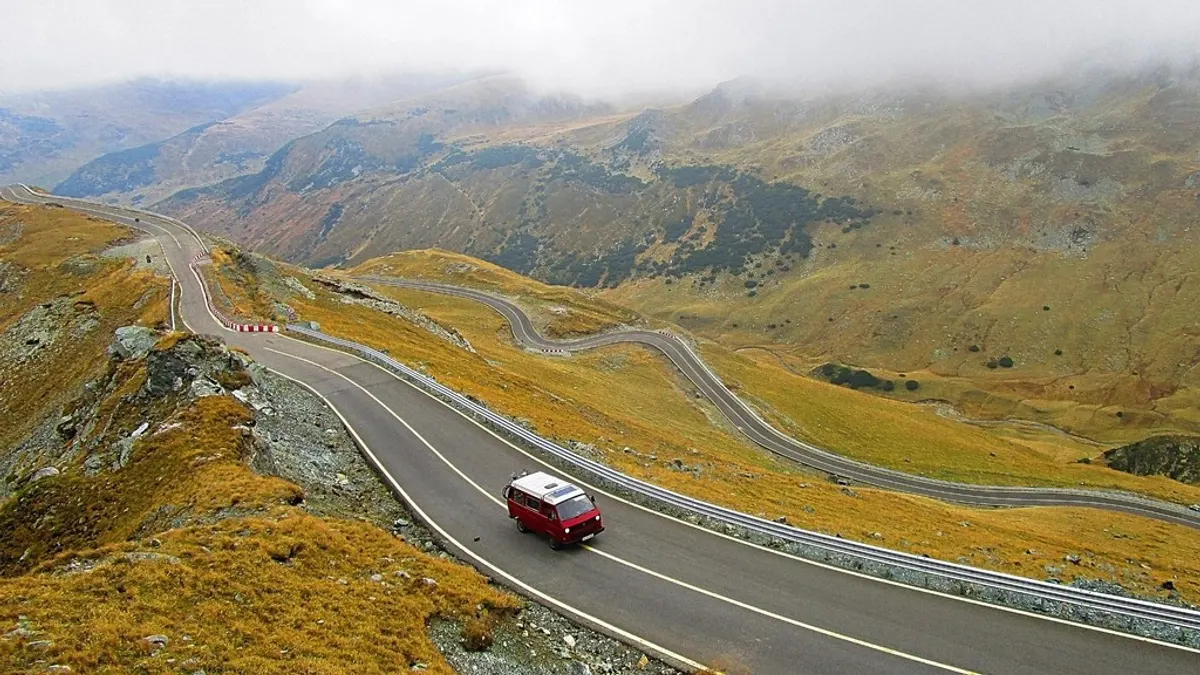
Cover photo: Driving Transalpina, CC0 1.0, via rawpixel. Cropped.
Related guides

Best Carbon Monoxide Detectors for Vans in 2026
CO alarms for vans with heaters, stoves or generators nearby.
Camper Van Build Guide: The Gear That Makes a Van Livable
Start here: what each system needs and where to read more.
Carbon Monoxide Safety in a Van: Heaters, Stoves and Generators
Where CO comes from in a van, and how to keep it out.